Friday, March 7, 2008

"The country does not give back what its history promised..."

More Griel Marcus mind-boggle. The following passages are ones that I found in the chapter (the first chapter, no less) wherein Marcus meshes together analyses of two American novel trilogies, John Dos Passos U.S.A. trilogy and Philip Roth's American Pastoral, I Married a Communist, and The Human Stain as well works and lives of Herman Melville, Ralph Waldo Emerson, Sinclair Lewis and many others, all the while harkening back to speeches by Abraham Lincoln, Dr. Martin Luther King Jr., Thomas Jefferson and many others, connecting them all to numerous references in culture (pop and otherwise) to come up with a blindingly real impression of American identity.

This-
The country charges its citizens with the mission to create themselves, just as the republic was created--but if each American carries the republic within himself or herself, then each American can become a lost republic. "This country is frightening": part of what is frightening is the apprehension that the republic itself can vanish in an instant, leaving each American unknown to every other, with nothing in common, in a state of nature, "a war of all against all," where the mob can come for anyone at any time. Jefferson opens a continent; it is filled up with great cities bursting with speeches and commerce. Blink your eyes and it is filled up with the zombie cities of Invasion of the Body Snatchers...with the citizens bent on the destruction of liberty even as an idea.


I love his language here. Its a challenge. Accountability, self-discovery, good will toward man--all of that. And more. It's like he's scaring us into it. Marcus is a smart man--is that what it's come to?

And this-

...the U.S.A. is a place and an idea and a speech of the people that always maintains its power to surprise and shock anyone who thinks he or she has seen it for what it is, because...American identity cannot be taken away any more than it can be granted. It is found discovered, made up, a declaration that each must make.

This, at once, gets to what it is great and awful about America--a fist in the air to the confusion and frustration and a charge to those of us who claim America has no identity of its own to dig a little deeper, into the country and into ourselves. This also puts us on the same playing field as our "founding fathers," for what do they got that we ain't got? We're just as American as they are, no older no newer, because we are constantly reinvented. Each day a declaration of independence. And here is why--

In a country based on an idea, made up, not merely the Declaration of Independence promulgated and the Constitution adopted but that nation promulgated and adopted, you don't [ever really] know. As captured in a few of Lincoln's words even more than in its founding documents, America is an idea--an idea that mapped the landscape and shaped the people in it, or failed to.


We need this right now. We will decide where to take our country in the next few months. And though I used to think that voting was the most important thing because it was all we had, I am realizing that we have way more. And it starts with US.

mark.

Tuesday, March 4, 2008

Happy Ultra Duper Duper Tuesday!

Well it seems as though we have another one of those days where the race for the Democratic nominee for President is supposed to be decided. Hooray!

In Super Tuesday fashion, I've compiled some of my favorite political writing from the past couple of weeks for your reading pleasure if you're interested or really, really bored.

First, we'll start with Ben Smith's blog at Politico. It's a nice, well-reasoned, non-partial (as far as I can tell) account of the campaign. He'll probably be live-blogging during the primaries today. Won't that be fun?

Also at Politico, this article by Roger Simon on Clinton's two-step tactics, which sometimes smack of Bush/Rove and make me a little sick. It gives the sense that either campaign could fall apart at any moment.

A couple things from The New Republic:
John B. Judis, who is unsympathetic to Obama, wrote an article called American Adam, which paints him as a harbinger of American rebirth, something I touched on yesterday.
And this piece called Race Man, making a pretty unsubstantiated attempt to accuse Obama of reverse race-baiting during his campaign.

And this brilliant op-ed with a great title from my personal favorite political commentator Frank Rich of the NYT. If you read nothing else today, please read this.

Finally, a piece that came out today from David Brooks, also of the NYT, who doesn't seem to care for Clinton or Obama, about the night Obama pulled the rug out from under Clinton and the conventional wisdom of the entire Democratic Party. And, just for fun, let's link that speech at the Jefferson Jackson Dinner.

Okay, that ought to keep us busy for a while. Hope your super-mega-ultra-make-or-break-or-do-or-die day is fine (it's going to spring rain in New York!) and to all our friends in Texas, Ohio, Rhode Island and Vermont (because we have tons of friends in Texas, Ohio, Rhode Island and Vermont) please remember to exercise your right to tell someone you think they're better than someone else.

Word up.
mark.


Monday, March 3, 2008

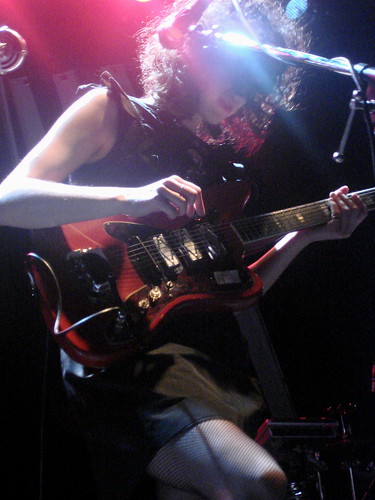
St. Vincent at Bowery Ballroom (2/29)


I had no idea she was so punk rock.

Annie Clark played Bowery (her "favorite venue in the whole world" or some trumped up claim like that) on Friday. I liked it quite a bit, but my expectations were completely flipped. I came away with much more respect for her as a musician and her album, and I found out that she is someone I wouldn't really like to hang out with.

I mean she's stupidly cute for god's sake. I'd think that "cute" is, then, the last thing she'd need to go for. But when she chats up the crowd, it's what she's doing. Like her completely inane story about some truck stop in Montana and taxidermy and a pony (which did provide one funny anecdote, "I don't know if any of you have ever left New York city ever, but...") all to get to the point of playing a solo cover of The Beatles "Dig A Pony," which turned out to be a highlight of the evening. "Why, oh, why," I wondered, "with the lame convo, Annie?" I attribute it to her being a hell of a lot better at expressing herself through song than chit-chat.

I was floored at times by how much rocking was going on. Her band was balls out--that fiddle player, shredding horse hair all over the Bowery stage. The drummer had a penchant for overindulgence, going a little overboard when it wasn't necessary ("drumboree" I like to call it). But I'll take that over being all reserved. The crowd didn't seem to dig it too much. They started to bounce (not literally--I mean leave--this is New York after all, the land where no one dances) about 2/3 of the way through the show (it was way cold in there, too, something that can possibly be attributed to lack of performance energy coming from the stage, or the disinterest teeming from the audience, or both).

She's a helluva guitar player--very precise and rhythmic with a crunchy tone. Her sporadic flitting in triplets, which causes her hair to balloon up over her face, makes her guitar cough and hack. It's quite jarring and a lot of fun. She's a really tense player, which has an effect on her voice (which isn't amazing to begin with--peculiar but not sound).

There was an overall explosion of the songs on Marry Me (a standout record of last year, to be sure)--a surefire arena-rock ending to "Now, Now", a Sonic Youthesque grind to "Your Lips Are Red". "Paris Is Burning" was perhaps the most exploded--a slow dirge to begin and ended with a celebratory storming of the Bastille. The songs were wild and at times out of control. She seemed much more at home, much more honest when enveloped in these explosions she created than when confronted with an audience.

I think her cuteness persona is what deceived the Bowery crowd. They came expecting something whitebread, something lukewarm, something Feist-y and got something colder, rawer and more rock and roll than they bargained for. I'm cool with that, its at least an interesting method of deception. But I'd ask Ms. Clark to kindly not do that next time. Just be real with us.

mark.

(Photo St. Vincent @ Bowery Ballroom NYC courtesy of Amy Wagner)

Happy March...

Spring is certainly all up in the air. Its nice to be outside again, the sun is shining, and maybe--just maybe--people will start to be a little nicer, and it won't be s'damn cold in my apartment in the morning.

I found this last night reading Griel Marcus' The Shape Of Things To Come. Its an intense and difficult (read challenging, strangling) book about, essentially, America's constant cycle of betraying itself and the promises it was founded on (and that it keeps making). He looks a lot at how American artists, politicians and public figures (David Lynch, John Dos Passos, Abraham Lincoln, Martin Luther King Jr. to name a few) prophecy this betrayal. It is an eye-opening and frightening read to delve into while we are in the throes of trying to reinvent ourselves as a nation (yet again), coming off the heals of a fierce betrayal heading potentially into another.

For spring time--for election year:

The pursuit of happiness is a national drama played out before an imaginary audience, an audience that includes all Americans, living and dead. As an actor, one seeks oneself; one also seeks to fulfill the aspirations of all those less brave, knowing that to fail one's own quest means the betrayal of everybody else.


Coming upon this during a particularly difficult night, it ruined me.

Happy March.
March on...
Mark.

Friday, February 22, 2008

Rufus at Radio City (2/14) and "Blackout Sabbath"

Had the immense pleasure of seeing Rufus Wainwright at Radio City Music Hall on Valentine's Day last week. It was my third time seeing him and I will certainly take every opportunity I can in the future. The first time was in the spring of 2001 in Detroit, a few weeks before Poses came out. The second was in New Orleans a few weeks after Katrina. All three were vastly different shows. The first was with a small band (including his pre-fame sister, Martha). Though Rufus was visibly fucked up for the whole show, that band was spot on, with some of the most pristine harmonies I've ever experienced. The second show was just him and a piano (or a guitar). Want Two had been out for a couple years (and Rufus had been clean) and Release the Stars was a thought on the horizon. I will never forget what the first notes he sang in the first song he played, "The Art Teacher," did--gripping, wrenching. He has the most penetrating voice.

If the first show was an artist at his creative peak (and most self-destructive--makes one wonder how connected the two are), and the second a chance to see his virtuosity as a singer/songwriter, the Radio City show was a full-on demonstration of celebrity. It had all the accoutrement of a big budget stage show--flashy lights, costume changes (!!!), even pyrotechnics (I have to admit that I didn't catch the pyro because I had to go to the bathroom and I took the opportunity to do so during "Slideshow" because that song is dreadful). His between-song-banter seems very self-congratulatory and puffed-up, but in an ironic, self-conscious way (also, he is ridiculously funny). His fame allows him to take more risks, though, as demonstrated in his singing to the auditorium with no microphone on the Irish traditional "Macoushla." The overblown spectacle and kitsch of co-finale "Get Happy" (decked to the nines in miniskirt, high heels and fishnets, and his band as dancers in Nun's habits--delightful) was positively decadent.

While I think his songwriting has seriously suffered in recent years--admittedly, Release The Stars still takes me over, though about half of it is boooor-ring--he is still incomparable. And, as evidenced last week, he is an incredible performer. Although, I maintain that he needs female back-up singers. His band on this last tour was all boys, who were great musicians but sub-par singers. Some of those female parts (most of which are Martha's--see "Poses," see "14th Street") are essential to Rufus' songs. Even at the solo show in NOLA he asked for help with the back-up part on "April Fool's" and, though most of the audience was timid, there was one lone voice from the back of the auditorium that made that song soar. Martha was even there at the NYC show--she and their mother, Kate, joined the band for a few songs, including Across the Universe with Sean Lennon--but just let those incredible harmony parts go unsung, or at best sung unsuccessfully.

Wow. Didn't actually mean to write that much about the show. Really wanted to write about Blackout Sabbath, which he announced at the show. Its a voluntary blackout of Manhattan on the summer solstice--a time to ponder what we can all do for the environment. Its a really lovely thing that, like all things Rufus, has a nice layer of cheeseball to it. Anyway, I'm advocating it. Check it out. He's also playing an unamplified, candlelit concert at the Angel Orensanz Foundation on the Lower East Side. Can't go because of rehearsal but I'm looking forward to the YouTube clips.


One last thing. It's really nice seeing concerts in New York and hearing the artists say, "its nice to be home." This happened the night before at the Yeasayer concert, too. Not sure what it is--warmth, comfort maybe. It reassures me that they mean it, perhaps. It's nice.

Friday, February 15, 2008

Yeasayer at Bowery Ballroom (2/13)


As one of the final shows of their co-headlining tour with MGMT, Yeasayer played a sold-out show at Bowery Ballroom on Wednesday. Since its a co-headlined tour, the bands trade nights as closers. Tonight they played first. Would have liked to have seen their show at Music Hall of Williamsburg on Thursday but was at another Music Hall (Radio City) instead seeing Rufus Wainwright (more on that later). Its a blessing and a curse of the city. I think the Bowery show was a little heavy on the MGMT supporters and expect the inverse of the Music Hall show. Whatever the case, Yeasayer was amazing.

It was my first time seeing them and they were much darker than I expected, a little more upset, unsettled, more aggressive. They have been touring pretty gruelingly for a month (not a great feat for more experienced bands but difficult I'm sure as a first time) and they were visibly worn. Lead singer Chris Keating spoke unfavorablly about the experience. "There's a lot of country out there. And it isn't pretty. Some of it's pretty. But a lot of it isn't pretty." This exhaustion, with, perhaps, an excitement to be back on home turf, had a marked influence on the songs.

The beats were meatier, the builds a little more impatient. Keating had to work harder to get the sound out, inviting the veins. He is more interesting when not tied to the keyboard/noise table, convulsing around, bending and contorting, giving the words and notes a body. This was evident during one of the highlights of the show, an amped-up and more urgent version of "Final Path," a demo song not on the album.

The All Hours Cymbals songs were harsher, more urgent, too. They were lacking in the optimism that is a driving force of the album. Were it not for the lyrics, one would think the band feels we're going down a path of sure destruction. Their final song of the set, "Wait For The Wintertime," I was certain couldn't get any heavier than the album has it. Clearly they found more ferocity in the blizzard of that song. As Keating sang,"that's the price you pay for the summertime," it became clear that it may be more difficult to be optimistic than All Hours Cymbals thinks.

Thankfully, for us at least, that difficulty forces them to dig so far into the beats and rhythms of "Sunrise" and "2080" that, if nothing else, we can dance. And the songs were held together taut by Ira Wolf Tuton flowing effortlessly on the fretless bass and Anand Wilder's Middle East-influenced meandering guitar riffs and those massive harmonies. The band may be taking from several sources, but it is never for personal gain. They are exploring, in search of something. And the songs lend themselves to feeling and expression--to growth. That is a refreshing thing, even when its a little scary.


Which leads us to MGMT, who are a pretty unfeeling band. I like Oracular Spectacular okay, buts its not the most honest piece of work I've ever heard. And for as fun as those songs are, their live set was rather stagnant. Violens, who opened the show, had a nice set. Technically sound, to be sure but a little boring and a little derivative. I'd see them again.

And again, that goddamn thing where no one wants to dance...

Ugh.
mark.

Wednesday, February 6, 2008

Do You Wanna Dance?

Today I began reading “definitive” biographies of possibly my two biggest heroes. Damned To Fame and Catch A Wave both have been cited as “ the” biographies of a lifetime, following, in great detail, the lives of Samuel Beckett and Brian Wilson (respectively). Starting them at the same time may prove to be too much, as I was a mess today – emotions all over the place. Chapter One brought me near tears in both book’s case (early childhood), and I can’t imagine what the rest has in store.

I have found the lives of these two brilliant artists very mournful for, often times, elusive reasons and their apt biographers have begun to unravel the mystery for me. What specifically were these emotions I was experiencing all day? Where did they come from, and why couldn’t I shake them off?

I believe the first, most natural, response was an ever-increasing sense of wonder at how these men emerged the artists they were. Beckett’s highly sensitive hearing capabilities sent his imagination soaring as a child, as he watched the oft-referenced lurches from his bedroom window. He drifted to sleep countless nights with the far away bark of dogs, the whispers and cries of the trees, the grass, and even the smallest grains of sand skittering across the driveway.

“Everything cries out,” the young Beckett must have thought.

Wilson, weeks before his first birthday, rode contentedly on top of his soon to be highly abusive father’s shoulders. In high spirits, Murray Wilson began singing “When the Caissons Go Rolling Along.” To his amazement, two verses into the tune, his eleventh month old boy began humming along in perfect pitch.

“Finally, a break has come! This boy will be my bragging right,” Murray may have whispered to himself. Columnated ruins domino?

What promise. What exactly the spirit and brains and guts of these two men cost them may be forever debated.

I began to ponder my own childhood. What promise.

Then came feelings of restlessness. What am I doing? Where am I going? There is something bubbling, something working to the surface that needs release. What is the cost and is it worth it? Will I enter decisively? Am I capable of choosing death? I wonder about the times that Beckett pondered these questions. I wonder what Brian would say, in a parallel universe in which he is still emotionally available and engaged. Was it worth it?

Wilson once said more or less that his father beat hit records out of him. He literally once publicly said that. One time. What did he spend his time publicly talking about? Love. Hope. Good vibrations. These signifiers appear in countless Wilson interviews (before and after his “fall”).

Where did Beckett find the love to create people with enduring spirit in a godless wasteland? This, to quote Winnie, “is what I find so…wonderful.”

Before this becomes aimless, I will close. There isn’t a moral here. There is no value in placing someone like Beckett or Wilson or (insert your hero here) on a spinning plate, high in the air saying, “I have to be this good before I die.” I just have to be willing to enter decisively, because, well, my surf’s up.

Seth.

Tuesday, February 5, 2008

Joanna Newsom and Brooklyn Philharmonic at BAM

Friday evening (2/01), had the opportunity to see Joanna Newsom and her "Ys Street Band" collaborate with the Brooklyn Philharmonic (Michael Christie, Music Director) at the magnificent Opera House at the Brooklyn Academy of Music. They played the compositions from her excellent 2006 album Ys from top to bottom, broke, and then she and her band came back to play a handful of older and brand new songs.

The first half brought out what is great about the songs, but it was not the transporting experience listening to the album can be. It seemed more exercised, and I never found myself swept away by her voice, her harp, or the incredibly lush arrangements. Thats not to say that it wasn't beautiful. I found myself thinking a lot about the songs, and came away with a much deeper appreciation for her as a songwriter. The songs are so instinctual, and will fly off in all sorts of directions, looping back over themselves and in and out, to great heights and depths. Sometimes she will stick in some rhythm for so long, vocally, that I start to lose sense of the lyrics. This may be her intent, though, for those moments are usually stream-of-consciousness images that seem to lose themselves in the rhythm. And when she comes out on the other side of them, I am completely spun around. Her performance here seemed more to that bent--a less conscious rendering of the emotional texture of the compositions. The string arrangements however, seemed more conscious and calculated. They seemed to follow her voice around, and cascade and collapse about it, like they were trying to make sense, at least emotionally, of what she was saying. I don't imagine thats an easy thing to do--her words carry a lot of weight. The arrangements, masterfully done by Van Dyke Parks for Ys and adapted and made playable for this orchestral tour by band member Ryan Fransesconi, seemed a separate entity from Joanna and her harp, which is such an interesting team to watch. The most moving piece of the evening came in "Sawdust & Diamonds," my least favorite song on the album, which is simply harp and voice.

In contrast, the second half was much more enjoyable. The songs seemed freer and more playful. They are so by composition's standards, but they also breathed way more. And she became the center of attention, a position, I get the feeling, though she is incomparably modest, she secretly enjoys. Knees bouncing and smiling brightly, she dug into the songs much more. There was no losing of the image to the rhythm like in the first half, she was present on every word. Her voice sometimes gets lost in the moment, in the side of her mouth, or baring down on her throat--probably an effect of the difficulty of playing the harp and singing simultaneously (I can't imagine). On the first new song she played of the evening, it was more open, more penetrating than I've ever heard it. And her fingers, when they gesture after plucking the harp's strings, seem to be somehow attached to them.

The evening took on a whole new meaning for me after a moment that came about half-way through the second set. I had been feeling (without noticing it) particularly happy to be in America after the song "Inflammatory Writ." It sounded to me so quintessentially American, harkening back to folk and western traditional song, by a visionary composer not yet at the peak of her artistic career. And I appreciated where I was, in a gorgeous Opera House run by one of the finest arts institutions in the world. And then within a few songs the band paused to mention Barack Obama and the Opera House erupted. Then her percussionist, Neal Morgan, spoke about how he canvased for Obama, and he brought up Hawaiian Congressman Abercrombie's endorsement of Obama as the first "citizen of the world" to run for president. Again, applause.

It was delightful and humbling and for some reason I started to love the American-ness of everything--Ryan F's banjo, Maggie Gyllenhaal sitting a few rows over, Joanna's boney bouncing knees, "Clam, Crab, Cockle, Cowrie." Can't remember feeling like that before.

mark.

Happy Super Fat Tuesday!

Happy Mardi Gras, all. How fitting on this day of indulgence that we will also embark on our most politically indulgent venture of recent memory: Super Tuesday, when 24 states will hold their primaries or caucuses. It's so super this year, they added a Duper. That's right: Duper.

In celebration thereof, rather than rattle off predictions and the results of my fervent analysis, I'm just going to link to a couple of things I've read that I liked.

This is by Matt Bai and is from last weeks Times Magazine. Its a look at super-delegates (a confoundingly stupid scheme to keep the party together) that says today's contest will probably render the Democratic contest moot, to be judged by a small body of self-important party officials (who seem to have only the party in mind, not the rest of the world, and who also include the Clintons).

This is Michael Chabon's argument on why everyone should support Obama. It makes sense but I think he's kind of a jerk about it.

And this is by Jesus, er, Frank Rich. Just read it, please.

That's all. Hope you enjoy and that you vote today if you can or if there is a contest in your state.

Dupermark.

update: Obama, too, is a superdelegate. Also, found this article by Marc Lamont Hill on why not to support him.

Friday, February 1, 2008

Rise Above

Suddenly this album struck me. I have been listening obsessively for days. I think I need to get this out...


The story goes--Dave Longstreth, rummaging through some old tapes, found the case to Black Flag's Damaged, an album which he was obsessed with as a kid. There was no cassette, only the liner notes. At some point he decides to use his discovery, re-imagining Damaged without revisiting. All he has is his memory, his artistic openness, and his mastery of craft. The result is Rise Above by his outfit The Dirty Projectors, released Sept. 11, 2007.

Essentially, its an album about memory--a picture of a man reflecting with nostalgia, regret, at times disgust, on his life post-punk. In "No More," when Longstreth, with a voice as free as a geyser, as controlled as a laser, laments with a belt, "every night I get drunk," arching the last word with a lilting falsetto, his self-hatred is palpable. He has fucked up, and now he has to live with it.

Even physically, what happens with fingers and drums. Its effortless. The entire virtuosic intro to "Spray Paint (The Walls)" or the guitar breakdown (literally, breakdown) on "Rise Above" feels like the buzz of the appendages themselves are keeping them moving, the body is numb, half-asleep. The fingers just move, of their own accord and out come these jolting and perfectly melodic phrases or waking lilts. The fingers of someone who has been there before, who’s seen it all before, and can’t bring himself to care, but the marks of age are bubbling up to the scarred surface.

But this interpretation of the album hardly scratches the surface of its depth.

For as raw and emotional as the album is, as compositionally sophisticated, and as, yes, beautiful as it is, its still, to its core, punk rock. It is anti-establishment intrinsically in the most gut wrenching and sorrowful and, at least in the title track, hopeful way. It doesn't have to be vocal about it.

And musically it is doing something that punk rock can no longer do. The album is jarring on a sonic level. The collision of disparate musical elements, abrasive time signatures, pounding rhythms that crash in before their welcome, tortured vocal chords that penetrate a little too loudly, and for a little too long, create an aggressive tension of unrest—nothing is going right, and someone is disturbed about it. If Damaged is an album, lyrically and musically, about a man railing against his situation in the world, a political album, Rise Above is deeply personal, a reflection on the man himself, in the context of his noisy world. While the anti-authority sentiment is considerably more tired, the emotional earnestness is painfully present.


It exists behind Damaged, underneath it, and moving through it. With Damaged, Black Flag was unabashed with how fucked up their lives were. They would go out, wreak havoc, get busted by the cops, go home and get wasted. Longstreth turns that into Rise Above, a dissection of what is beneath all that—the fear, insecurities, desire for a better life—manifesting itself in such destructive ways. For that, with its fierce sensitivity and intellect, it is a braver record, deeply indebted to the tunnel-vision of its past, and ready to move on.

In real time, it is a perfect marker of how far we’ve come, how far the walls have been pushed out. Punk rock has been co-opted—a tragedy of modern music, not because the potential for a lot of great art was lost, but that it was allowed to happened at all. The effects of that led to a struggle to create independent music that could not be embraced, could not be spun. And, in a triumph of modern music, of which we are in the throes at the moment, the struggle did not lead us downward in the direction of Black Flag, but upward with more complex, difficult, personal music—music that is changing the landscape of rock ‘n’ roll (an already impossibly vast landscape) on compositional and emotional levels, in ways more profound than bands of the Black Flag ilk could have imagined. A look at the list we’ve created below, and we see artists—Grizzly Bear (who, to me, is the touchstone of this movement, and whose Chris Taylor co-produced Rise Above with Longstreth), Deerhoof, Menomena, Longstreth and co.—that are new pioneers, forging forward, constantly expanding the capacity of rock ‘n’ roll, refusing to accept that there are rules to what goes into a song. Rise Above is a formally masterful work of art. It is radical and beautiful and shows us that independent music may be the last art form where avant garde can actually still exist.


mark.